Why Your Front Door Might Be Your Biggest Security Risk
Your front door is your home's primary entry point. It's the one point you want to be unbreakable. But most homeowners focus on the wrong part of the door: the deadbolt.
A Grade 2 residential deadbolt can withstand significant hand pressure and casual tampering. In a forced-entry scenario, though, the deadbolt rarely fails. The door frame does. Understanding this distinction is critical because it changes what you should actually invest in to harden your front door.
The misconception: the deadbolt vs. the frame
Homeowners often assume that a stronger deadbolt is the answer to front-door security. This makes intuitive sense—the lock is the thing that keeps the door closed. But in forced-entry scenarios, security professionals and locksmiths consistently observe the same pattern: the frame fails first.
A standard residential deadbolt (Grade 2 or better, the minimum for exterior doors) is already quite strong. It resists direct pressure and casual lock-picking attempts. Where it fails is when force is applied not to the lock itself, but to the wooden frame the lock is mounted in.
The real vulnerability isn't the bolt. It's the thin wooden jamb that surrounds it.
How a standard residential door frame fails under force
To understand why frame failure happens, you need to see how a standard residential front door is assembled.
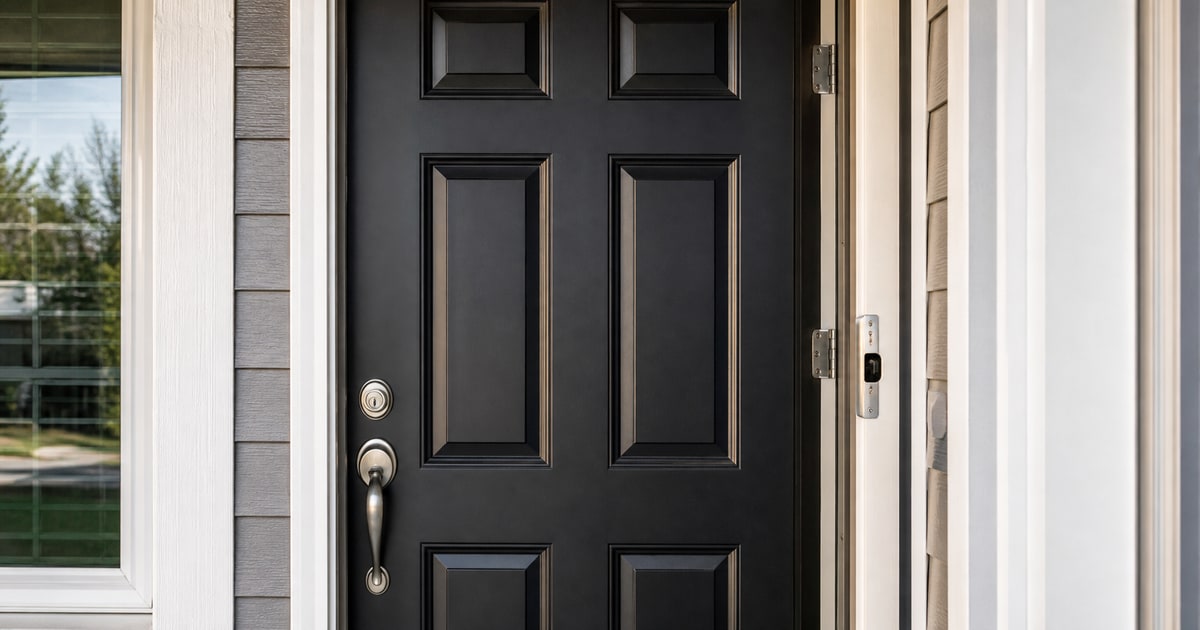
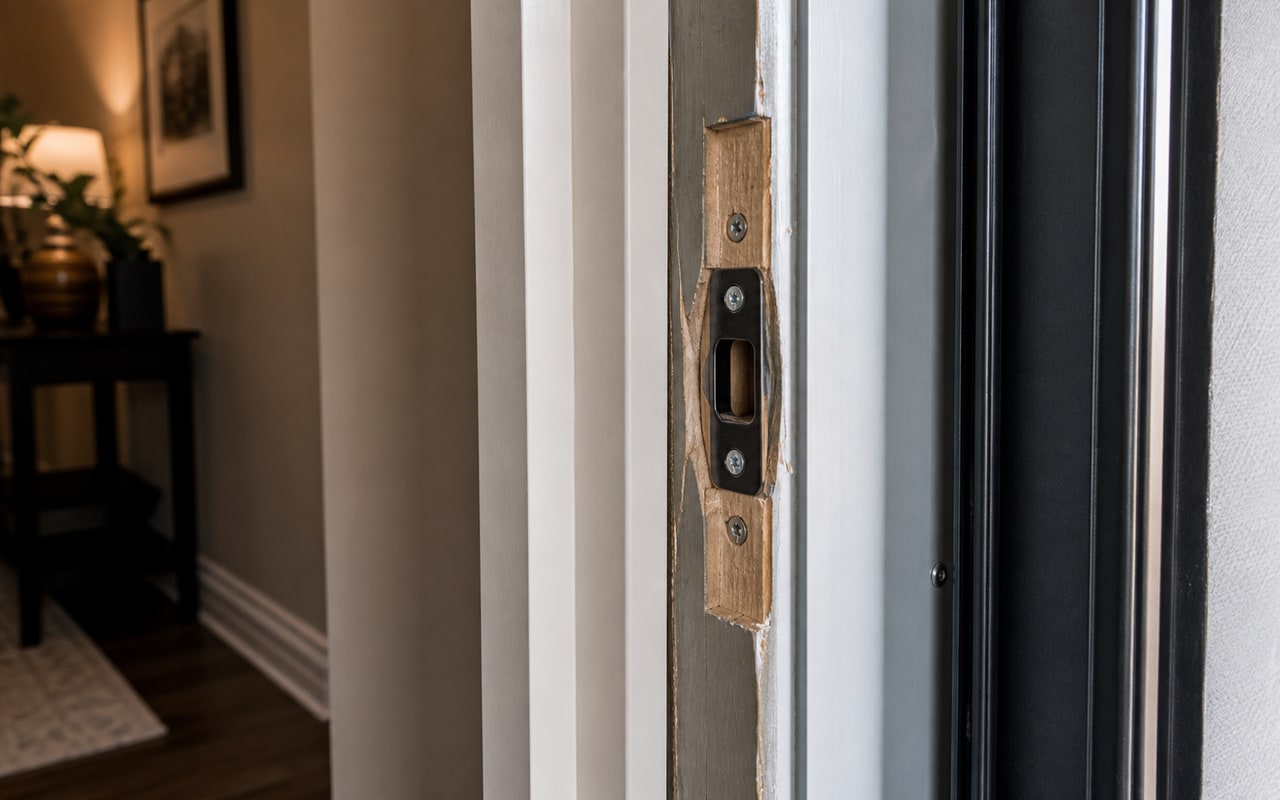
Door frame composition: The wooden jamb—the vertical piece of wood on the side where the lock is mounted—is typically a 1.5-inch thick trim board. Behind it sits the structural framing of your house, usually 2×6 or larger studs. But here's the critical gap: the fasteners connecting the strike plate (the metal part that the deadbolt latch engages) penetrate only 0.5 to 1.5 inches into the wood. They often stop at the thin trim board and never reach the structural studs behind it.
When a foot or shoulder strikes the door near the lock, the force concentrates at a small area of the wooden jamb. If the strike plate fasteners don't anchor all the way to the structural studs, the wood around the strike plate can split and separate. The lock is still intact. The door just swings open.
Fastener penetration matters. Standard installation uses short screws (often 0.5 to 1 inch long) through the strike plate into the jamb. Under repeated or forceful kicks, these shallow fasteners simply don't provide enough resistance. The wood fibers compress and split. The strike plate pulls away from the frame. Entry succeeds.
Kick-force testing (per ANSI standards used in the industry) applies 75 foot-pounds of force per strike to evaluate lock hardware. A Grade 2 deadbolt withstands 5 strikes at that force level. The frame, however, can fail in fewer strikes if the fasteners don't penetrate deep enough into structural wood.
The hinges are also vulnerable. On the hinge side of the door, similar fastening problems exist. Standard residential hinges use short fasteners. Lateral force applied to the hinge side can cause the hinge to separate from the jamb, allowing the door to swing open without defeating the lock at all.
Common front-door vulnerabilities
Not all front doors are vulnerable in the same way. Here are the patterns security professionals look for:
Single-bolt configuration
A single deadbolt is standard residential practice. It's not inherently weak—the strength depends entirely on the frame it's mounted in. A single bolt on a well-reinforced frame can resist forced entry for significantly longer than a single bolt on a weak frame. The bolt itself is rarely the limiting factor.
Weak strike plates
Strike plates vary widely in thickness and fastener design. Thin strike plates (18-gauge or thinner) bend under load. Shallow fasteners (anything shorter than 3 inches) don't anchor into structural wood. Both are common in builder-grade installations.
Wood frame condition
Older homes sometimes have solid-wood jambs that are stronger than modern composite frames. But older frames can deteriorate from moisture, age, or dry rot. A visibly damaged or soft jamb loses its ability to resist load. Conversely, newer composite jambs can be surprisingly weak under direct impact.
Gap alignment issues
If your door doesn't close perfectly—if there's a visible gap between the door edge and the frame—the strike plate may not engage fully. This reduces the effectiveness of the deadbolt and creates leverage points for pry tools. Older homes especially can develop alignment issues from settling.
Sidelight glass proximity
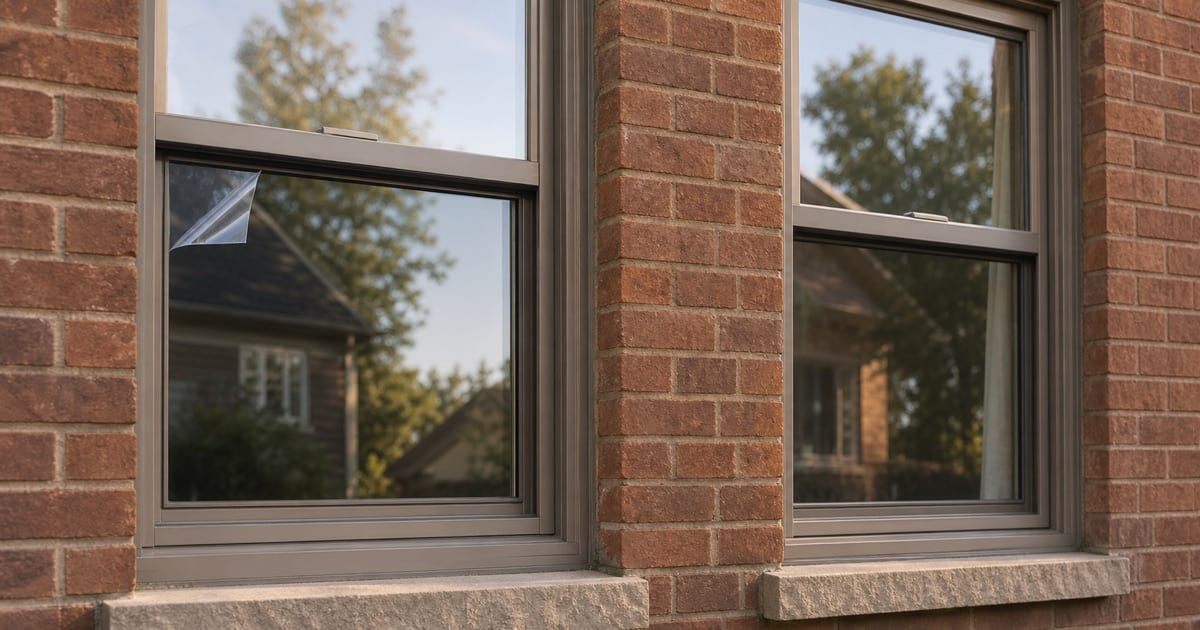
If your front door has sidelight glass (decorative glass beside the door, common in Victorian and Edwardian Toronto homes), the vulnerability changes completely. An intruder can break the glass, reach through, and turn the deadbolt from inside. In this case, frame strength is irrelevant—the lock can be bypassed without ever touching it. Sidelight glass should be protected with security film if the lock is within arm's reach of breakable glass.
What hardening actually does
The goal of door hardening is not to make your front door "unbreakable." It's to add delay and distribute the force across a wider, stronger structure.
When you reinforce a door frame, you're doing one key thing: anchoring the strike plate to the structural studs of your house, not just the trim board. This means the force from a kick must overcome the structural wood of your home, not just a thin jamb.
Frame reinforcement: Long fasteners (3 to 4 inches) spaced close together (4 to 6 inches apart) penetrate through the trim and deep into the structural studs. Now the force must overcome the shear strength of the structural studs, not just the compression strength of the jamb. This increases resistance dramatically.
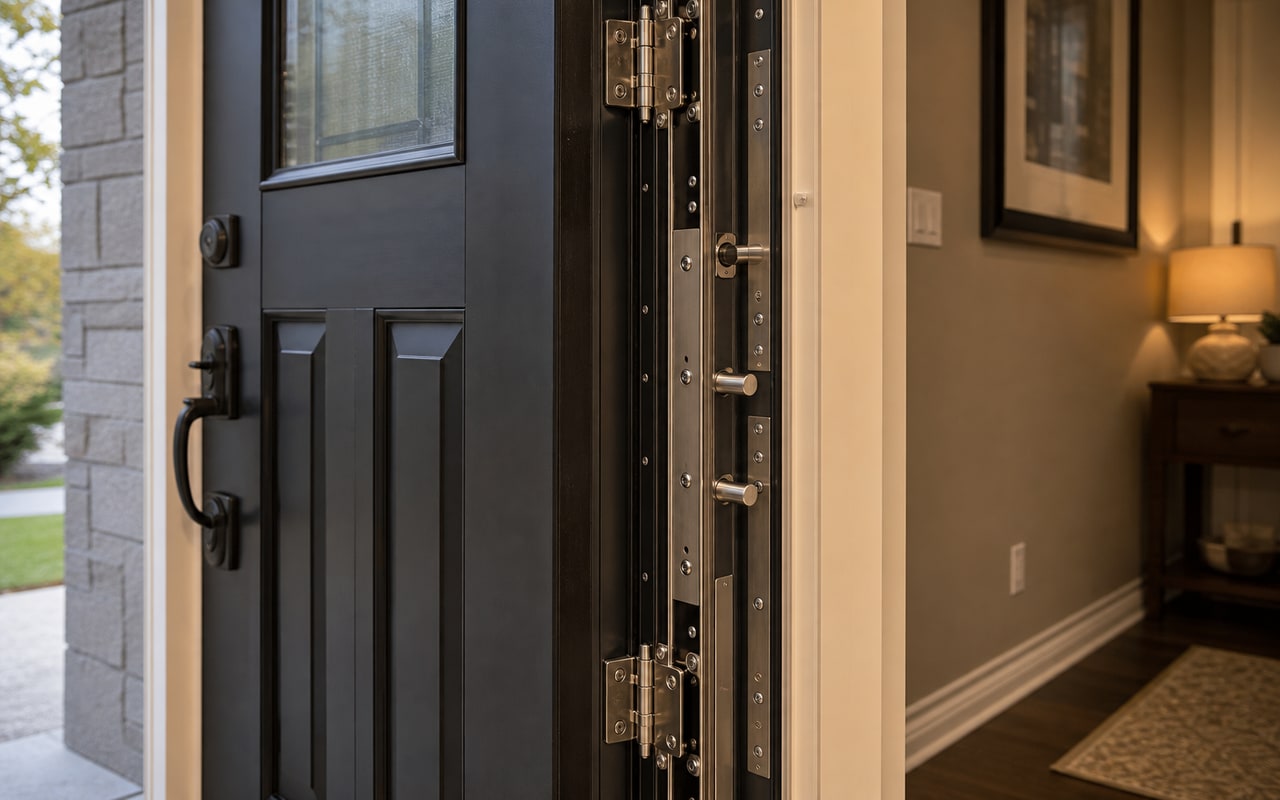
Multi-point locking: Adding a second lock point at the top or bottom of the door (in addition to the standard deadbolt) means force cannot be concentrated at a single point. The intruder must defeat both locks or apply force across a wider area. This adds delay and distributes the load.
Hinge reinforcement: Reinforcing or replacing hinges with security hinges resists lateral separation. This prevents the hinge side from failing independently, which is a common failure mode on standard residential doors.
Result: An unprotected front door can fail in seconds to a minute under sustained kick force. A properly reinforced frame resists forced entry for minutes. That delay is significant. It provides time for occupants to retreat to a safer room, call police, or trigger an alarm. It also deters opportunistic intruders, who move on when forced entry takes too long.
Hardening options: from simple to comprehensive
Strike plate upgrade
Replace the standard strike plate with a heavy-duty version that uses longer fasteners (3 inches or more) that penetrate into the structural studs. This is a DIY upgrade, costs $50–150, and provides modest but real improvement.
Door reinforcement system (ARX Guard)
A professional reinforcement system replaces the entire strike-plate assembly with a reinforced system that anchors to the structural studs with multiple long screws, adds multi-point locking via a hockey-stick mechanism, and reinforces hinges. Professional installation takes 1–2 hours. Cost: $300–600. Result: significant improvement in resistance to forced entry.
Supplementary locks
Add a keyed lock at the top or bottom of the door frame in addition to the deadbolt. These add friction and noise but are modest improvements on their own. Cost: $50–200, DIY installation.
Door replacement
If the door itself is damaged, the frame is not salvageable, or reinforcement isn't sufficient, replacement with a solid-core or steel door and security-rated frame may be necessary. Cost: $1,000–2,500, professional installation. This is comprehensive but warrants consideration only if other measures don't apply or if the door itself is already compromised.
Cost and practical advice: Most homeowners should start with a heavy-duty strike plate upgrade (quick, affordable, effective) or a professional reinforcement system (more comprehensive, longer-lasting). Door replacement is a larger investment warranted mainly when the door itself is damaged.
Not sure which option fits your door and your risk profile? A Clear Guard technician can walk the property with you and tell you exactly what reinforcement would look like on your specific entry. Assessments are free and take about 30 minutes.
A practical assessment for your own door
You don't need special tools to get a sense of your own front door's vulnerability.
From outside, stand at the lock-side edge of the door (the side where the deadbolt is mounted). Push firmly on the door at the lock. Does the door feel solid and immobile, or does it flex in the frame?
If the frame flexes noticeably, the fasteners may not be anchoring deep enough.
Look at the strike plate. How many fastener holes do you see? How deep do they appear to penetrate? If you see only two screws, or if the screws are very short, that's a sign of vulnerability.
Check the hinges on the other side. Are they standard residential hinges, or are they reinforced? Standard hinges can separate under lateral force.
This self-check doesn't replace a professional assessment, but it helps you understand your door's vulnerability profile. If the frame flexes, if the strike plate fasteners are shallow, or if hinges are standard, your door is a candidate for reinforcement.
Frequently asked questions
Is a deadbolt enough to secure a front door?
A deadbolt is a strong lock, but its effectiveness depends entirely on the frame it is mounted in. A Grade 2 residential deadbolt can withstand significant hand pressure and casual tampering. But in a forced-entry attempt with repeated kicks, the frame—not the lock—is usually the failure point. A weak frame will fail even with an excellent deadbolt. Frame strength matters more than lock strength.
What is the most common way a front door fails under forced entry?
The door frame, specifically the jamb where the strike plate is mounted, splits or separates under kick force. If the strike-plate fasteners penetrate only the trim board and not the structural studs behind it, the wood will split under repeated impact. The deadbolt is still intact, but the door opens because the frame has failed. Frame reinforcement that anchors to structural studs is more effective than upgrading the deadbolt alone.
How long does it take to reinforce a front door?
A professional reinforcement system (ARX Guard or similar) is typically installed in 1–2 hours on a single door. The result is significantly improved resistance to forced entry. A simple strike-plate upgrade can be done in under an hour by a DIYer, though the improvement is more modest than a professional reinforcement system.
Ready to assess your front door?
Your front door is the entry point most worth hardening. But the vulnerability isn't necessarily where you think it is.
Book a free on-site evaluation. A Clear Guard technician tests your frame, assesses your strike-plate setup, evaluates your door, and provides a written recommendation. No obligation.
Related reading
- Sidelight Glass on Heritage Front Doors: The Entry Point Most Homeowners Miss
- How Security Window Film Works: A Visual Guide
- Door Fortification
- Break-In Prevention for Toronto Homeowners: What Police Actually Recommend
- Layered Family Safety Planning: Detection, Delay, and Retreat
- After a Nearby Break-In: A Calm, Practical Checklist for Neighbours